Written by
Victoria Wells
Principal & Web3 Legal Lead
Published on
Jan 19, 2026
Quick Reality Check: What Nobody Tells You About UAE Stablecoin Licensing
VARA application fee "AED 40,000"? That's the Advisory Services rate. FRVA/stablecoin issuance requires Category 1 at AED 100,000 application plus AED 200,000 annual supervision. And that's before capital, compliance, and personnel costs push Year 1 above AED 2.5 million
ADGM's "$70,000 application"? That's accurate for FRT issuance, but budget AED 500,000+ for realistic Year 1 costs, and up to AED 50 million in capital for trading platforms
CBUAE sounds prestigious? It is. AED 15 million base capital plus 100% cash reserves in escrow. This framework is for major institutional players only
"3-4 month timeline"? More like 6-12 months when you factor in entity formation, documentation rounds, and regulatory back-and-forth
Comparing the three? Wrong question. Each framework serves fundamentally different business models
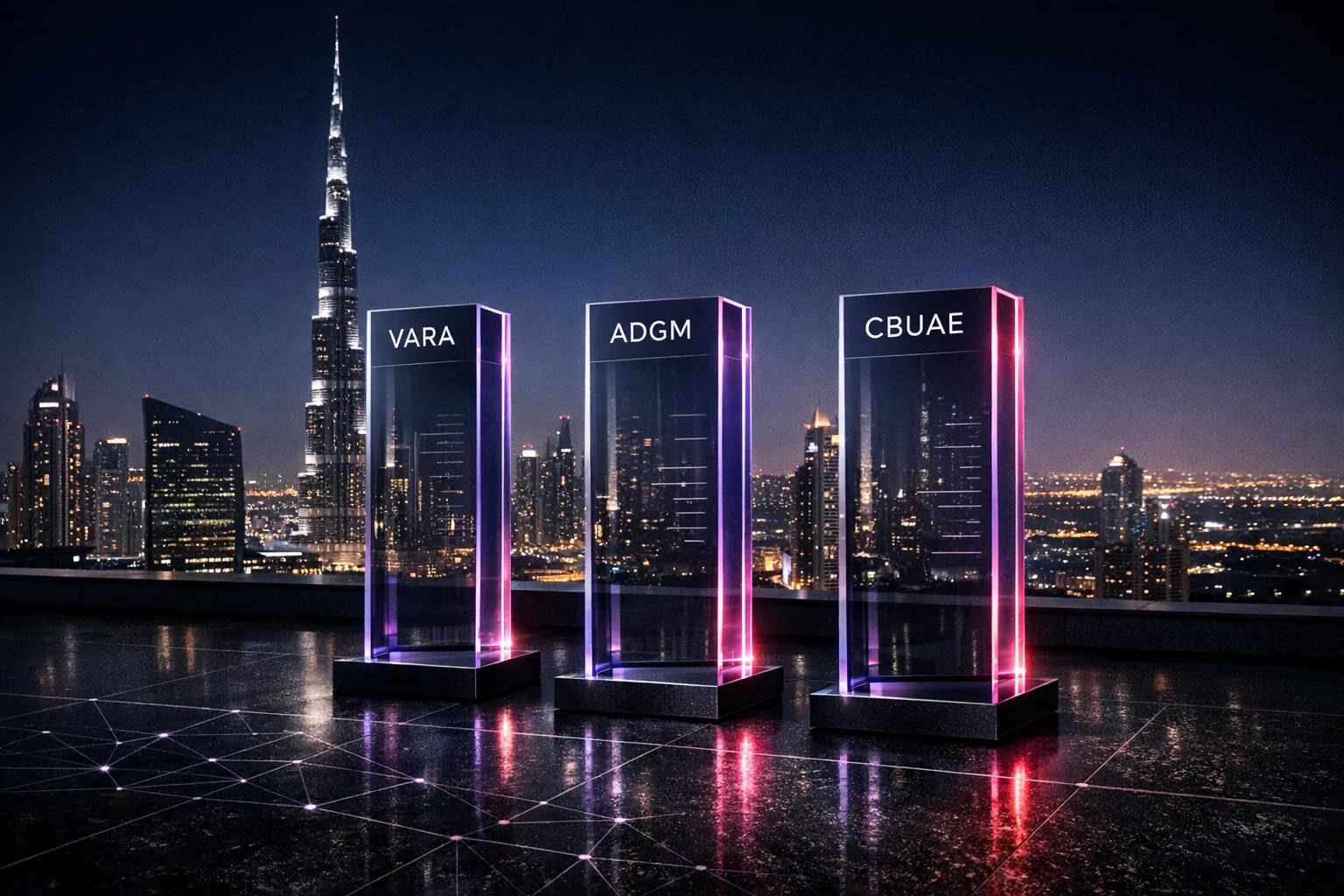
The UAE has three distinct stablecoin licensing frameworks, and picking the wrong one will cost you months of wasted effort and hundreds of thousands in misdirected spending. VARA handles non-AED virtual assets in Dubai. ADGM regulates fiat-referenced tokens in Abu Dhabi. CBUAE has exclusive authority over AED-pegged stablecoins across mainland UAE.
Here's the complete breakdown of what each framework actually costs, what they don't advertise, and how to decide which path makes sense for your project.
Quick Navigation
Framework Comparison at a Glance
Before diving into each framework, here's what you're actually looking at:
UAE Stablecoin Licensing: Advertised vs. Reality
Framework | Key Focus | Official Application Fee | Real Year 1 Cost | Capital Lock-Up | Realistic Timeline |
|---|---|---|---|---|---|
VARA (Dubai) | Non-AED stablecoins, FRVA | AED 100,000 (Category 1) | AED 2.5M-4M+ | AED 1.5M+ | 6-9 months |
ADGM (Abu Dhabi) | Fiat-referenced tokens | USD 70,000 (~AED 257,000) | AED 500K-2M+ | AED 250K-50M | 6-12 months |
CBUAE (Mainland) | AED-pegged tokens only | Not disclosed | AED 20M+ | AED 15M+ (100% cash) | 9-15 months |
Official fees from VARA Schedule 2 (2023 Regulations) and ADGM FSRA FEES Rules 3.9A (December 2024). Real Year 1 costs include capital, compliance infrastructure, personnel, and office requirements.
What Each Framework Prohibits
Restriction | VARA | ADGM | CBUAE |
|---|---|---|---|
AED-pegged stablecoins | ❌ Prohibited | ❌ Prohibited | ✅ Exclusive authority |
Algorithmic stablecoins | Case-by-case | ❌ Prohibited | ❌ Prohibited |
Privacy tokens | ❌ Prohibited | ❌ Prohibited | ❌ Prohibited |
Yield-bearing tokens | Restricted | ✅ Permitted | Not specified |
Retail distribution | ✅ Permitted | Institution-focused | ✅ Permitted |
Understanding these restrictions upfront saves months of pursuing the wrong framework. For broader context on UAE crypto regulations, see our comprehensive guide.
VARA Dubai: FRVA Licensing Costs
VARA oversees Full Reserve Virtual Asset (FRVA) providers in Dubai through a structured two-step licensing process. The framework specifically excludes AED-pegged stablecoins, which fall under CBUAE jurisdiction, but covers USD-pegged and other foreign currency stablecoins.
VARA Official Fee Structure
The VARA licensing process splits payments into two phases: 50% when submitting the Initial Disclosure Questionnaire (IDQ) and applying for Approval to Incorporate (ATI), with the remaining 50% due upon license approval alongside the first year's supervision fee.
Official VARA Fees (Schedule 2, Virtual Assets and Related Activities Regulations 2023):
VA Activity | Application Fee (AED) | Annual Supervision Fee (AED) | Notes |
|---|---|---|---|
Category 1 VA Issuance (FRVA/ARVA) | 100,000 | 200,000 | Stablecoin issuance requires this category |
Advisory Services | 40,000 | 80,000 | Lowest tier, not for token issuance |
Broker-Dealer Services | 100,000 | 200,000 | Required for distribution |
Custody Services | 100,000 | 200,000 | If holding client assets |
Exchange Services | 100,000 | 200,000 | For secondary market trading |
VA Transfer and Settlement | 40,000 | 80,000 | Payment processing only |
Extension Fee: 50% of lower License Application Fee for each additional VA Activity added to existing license.
Legacy Discount: Firms operating before February 2023 may qualify for up to 50% reduction in licensing fees and capital requirements through the Legacy Operating Permit program.
Key Clarification: The widely-quoted "AED 40,000 application fee" applies only to Advisory Services and VA Transfer/Settlement, the two lowest-tier activities. FRVA/stablecoin issuance falls under Category 1 VA Issuance at AED 100,000 application plus AED 200,000 annual supervision. Total official VARA fees for FRVA issuance: AED 300,000 in Year 1.
VARA Capital Requirements: The Real Numbers
Capital requirements for FRVA issuers are significantly higher than general VARA license requirements:
Requirement | Amount | Calculation Method |
|---|---|---|
Base Paid-up Capital | AED 1,500,000 | Flat minimum |
Variable Component | 2% of available supply | Based on token circulation |
Net Liquid Assets Buffer | 1.2x monthly operating expenses | Ongoing requirement |
Total Effective Requirement | Higher of the two calculations | Reconciled monthly |
This capital must be held in a UAE-licensed bank trust account with VARA as beneficiary. The opportunity cost alone on AED 1.5M+ sitting in a low-yield trust account runs AED 75,000-150,000 annually.
VARA FRVA Compliance Framework
FRVA issuers must comply with five mandatory rulebooks plus FRVA-specific requirements:
Rulebook | Key Requirements | Compliance Cost Impact |
|---|---|---|
Company Rulebook | Governance structure, board composition | AED 50,000-100,000 setup |
Compliance and Risk Management | AML/CFT framework, MLRO appointment | AED 100,000-200,000 annually |
Technology and Information | Cybersecurity, smart contract audits | AED 150,000-300,000 setup |
Market Conduct | Fair dealing, disclosure requirements | Ongoing operational cost |
VA Issuance Rulebook + FRVA Rules | Reserve management, redemption mechanics | AED 200,000+ compliance infrastructure |
For detailed VARA regulations, including the specific FRVA Rules, consult the full regulatory framework.
ADGM Abu Dhabi: Fiat-Referenced Token Costs
ADGM categorizes stablecoins as Fiat-Referenced Tokens (FRTs) and requires issuers to obtain a Financial Services Permission (FSP) to conduct money services. The framework operates under English Common Law, which appeals to international institutional investors but comes with steeper compliance requirements.
ADGM Fee Structure
The ADGM crypto license process involves two stages: In-Principle Approval (IPA) followed by final Financial Services Permission.
Official ADGM FRT Fees (FSRA FEES Rules 3.9A, effective December 2024):
Fee Component | Amount (USD) | Amount (AED) | Notes |
|---|---|---|---|
Application Fee (FRT Issuance) | $70,000 | ~257,000 | Single regulated activity |
Annual Supervision Fee | $70,000 | ~257,000 | Due annually |
Registration Fee | Variable | Variable | Entity-specific |
Additional Permissions | Per activity | Per activity | Cumulative if adding activities |
Total official ADGM fees for FRT issuance: approximately USD 140,000 (AED 514,000) in Year 1.
Note: The FRT framework was significantly updated in October 2025 with changes effective January 1, 2026. These updates expanded regulated activities to include custody, payment services, and FRT intermediation.
ADGM Capital Requirements: Activity-Based Scaling
Capital requirements under ADGM license categories vary dramatically based on licensed activities:
Activity Type | Minimum Capital (AED) | Additional Requirements |
|---|---|---|
Money Services (Basic) | 250,000-500,000 | Risk-profile dependent |
Digital Asset Custody | 500,000+ | Segregated client funds |
Digital Asset Trading Platform | 50,000,000 | Plus 1% of monthly average trading volume |
Client Protection Fund | 10% of client deposits | Segregated requirement |
The AED 50 million requirement for trading platforms makes ADGM prohibitively expensive for most startups. This framework targets established institutional operators, not early-stage projects.
ADGM Reserve and Compliance Requirements
FRT issuers face rigorous ongoing obligations:
Requirement | Frequency | Verification Method |
|---|---|---|
1:1 Reserve Backing | Continuous | High-quality liquid assets in same currency |
Reserve Reconciliation | Weekly | Mandatory reporting to FSRA |
Approved Persons | Ongoing | Key personnel must be FSRA-approved |
AML/CFT Compliance | Continuous | Full Virtual Asset Framework adherence |
Technology Standards | Continuous | Custody and security requirements |
In June 2024, Paxos received FSRA approval to issue USDL, a yield-bearing stablecoin. This makes ADGM the only UAE jurisdiction explicitly permitting yield distribution to token holders, a significant differentiator for certain business models.
For more on ADGM's regulatory approach, see our detailed analysis.
CBUAE Mainland: AED-Pegged Token Costs
The Central Bank of the UAE introduced the Payment Token Services Regulation (PTSR) in June 2024, establishing the most capital-intensive stablecoin framework in the country. This is the only pathway for issuing Dirham-backed stablecoins and represents a fundamentally different regulatory philosophy than the free zone alternatives.
CBUAE: Built for Institutional Players
Unlike VARA or ADGM, the CBUAE framework is designed for major financial institutions, not crypto-native startups:
Official CBUAE Capital Requirements (Payment Token Services Regulation, Articles 13-15):
Requirement | Specification | Practical Impact |
|---|---|---|
Base Capital | AED 15,000,000 | Non-negotiable minimum for Payment Token Issuers |
Variable Capital | 0.5% of outstanding tokens | Scales with token circulation |
Reserve Requirement | 100% in AED cash | Must be held in UAE bank escrow account |
Escrow Independence | Separate from issuing group | Cannot use affiliated bank |
Application Fees | Not publicly disclosed | Contact CBUAE directly |
Note: For Payment Token Custody and Transfer or Conversion providers, capital requirements are lower: AED 3 million if monthly average value is AED 10 million or more, or AED 1.5 million if below that threshold.
CBUAE Compliance Infrastructure
The operational requirements create additional cost layers:
Requirement | Duration/Frequency | Cost Impact |
|---|---|---|
Operational Testing | 6-month mandatory period | Delays revenue generation |
UAE Switch Integration | Pre-launch requirement | Technical integration costs |
Monthly Performance Reports | CEO and CFO signed | Ongoing administrative burden |
External Audits | Financial statements, reserves, White Paper | AED 100,000-300,000 annually |
Physical Mainland Presence | Continuous | Cannot operate from free zones |
In late 2024, a consortium including IHC, ADQ, and First Abu Dhabi Bank announced plans for a Dirham-backed stablecoin under this framework. This signals that CBUAE licensing is realistically accessible only to well-capitalized institutional consortiums, not independent crypto projects.
What CBUAE Prohibits
The framework explicitly bans:
Algorithmic stablecoins (no unbacked or partially-backed models)
Privacy tokens
Operations from ADGM or DIFC (must be mainland UAE)
Reserve assets other than AED cash
These restrictions align with the Central Bank's focus on financial stability over innovation.
Hidden Costs That Blow Your Budget
Every consultancy in Dubai will quote you the official application fees. Here's what they don't mention:
The Responsible Individual Problem
All three frameworks require qualified UAE-based personnel. For VARA specifically, you need two full-time Responsible Individuals who are UAE residents or passport holders:
Cost Component | Amount (AED) | Annual Impact |
|---|---|---|
Recruitment Fees | 20,000-50,000 | One-time |
Salary (each RI) | 120,000-300,000/year | AED 240,000-600,000 total |
Visa Sponsorship | 15,000-20,000 each | If not already resident |
Training/Certification | 10,000-30,000 | VARA-specific requirements |
Finding qualified candidates who understand both traditional compliance and crypto mechanics is genuinely difficult. Budget 2-3 months for recruitment alone.
Physical Office Requirements
"Remote-first" doesn't work here. All three regulators require physical presence:
Jurisdiction | Office Requirement | Annual Cost Range (AED) |
|---|---|---|
VARA (DWTC) | Private office, not flexi-desk | 75,000-250,000 |
ADGM | Registered office in Abu Dhabi | 50,000-150,000 |
CBUAE (Mainland) | Full mainland presence | 100,000-300,000 |
For DIFC or DMCC alternatives (where stablecoin issuance may be limited), costs vary but physical presence remains mandatory.
Compliance Infrastructure
Your compliance framework isn't a one-time document. It's ongoing operational infrastructure:
Component | Setup Cost (AED) | Annual Maintenance (AED) |
|---|---|---|
AML/CFT Systems | 50,000-200,000 | 60,000-240,000 |
Transaction Monitoring | 100,000-300,000 | 120,000-360,000 |
Cybersecurity Audit | 30,000-100,000 | Annual requirement |
Smart Contract Audit | 50,000-200,000 | Per major update |
Legal Counsel (Ongoing) | N/A | 100,000-300,000 |
For guidance on VASP compliance requirements, see our detailed breakdown.
The Capital Opportunity Cost
Locked capital earns minimal returns while competitors deploy theirs:
Framework | Minimum Locked Capital | Annual Opportunity Cost (at 5%) |
|---|---|---|
VARA FRVA | AED 1,500,000+ | AED 75,000+ |
ADGM (Basic) | AED 250,000-500,000 | AED 12,500-25,000 |
ADGM (Trading) | AED 50,000,000 | AED 2,500,000 |
CBUAE | AED 15,000,000+ | AED 750,000+ |
This dead money could fund a development team, marketing, or market-making partnerships.
Decision Framework: Which Regulator Fits Your Project
Choosing the right framework depends on your token type, target market, capital position, and long-term strategy.
Choose VARA If:
✅ You're issuing USD-pegged or other non-AED stablecoins ✅ Your target market is Dubai-based retail and institutional users ✅ You have AED 2.5-4 million for Year 1 total costs ✅ You can commit to 6-9 months licensing timeline ✅ You want to operate within Web3 Dubai's growing ecosystem ✅ You qualify for legacy discounts (pre-February 2023 operations)
Choose ADGM If:
✅ You're building institutional-grade products ✅ You want to issue yield-bearing stablecoins (ADGM is the only UAE option) ✅ English Common Law jurisdiction matters for your investors ✅ You have AED 500K-2M for basic licensing, or AED 50M+ for trading platforms ✅ International recognition outweighs speed to market ✅ You're comfortable with banking-level compliance requirements
For more on ADGM's institutional focus, see our jurisdiction guide.
Choose CBUAE If:
✅ You're issuing AED-pegged stablecoins (this is your only option) ✅ You're an established financial institution or well-funded consortium ✅ You have AED 15M+ in base capital plus 100% cash reserves ✅ Integration with UAE's national payment infrastructure (UAE Switch) is valuable ✅ Consumer deposit insurance matters for your use case ✅ You can wait 9-15 months for full licensing
Look Elsewhere If:
❌ You're bootstrapping with under AED 1 million ❌ You need to launch in under 6 months ❌ Your model relies on algorithmic mechanics (prohibited everywhere) ❌ You want to avoid physical presence requirements ❌ You're testing product-market fit before committing to compliance
Alternative approaches include starting with a DMCC crypto license for general crypto activities, then adding stablecoin capabilities once your model is proven. Some projects also consider Singapore vs Cayman structures for initial launch before UAE expansion.
Timeline Reality Check
Published timelines are marketing numbers. Here's what actually happens:
VARA FRVA Timeline (Realistic)
Phase | Duration | Activities |
|---|---|---|
Pre-Application | 2-3 months | Entity formation, documentation prep, RI recruitment |
IDQ Submission | 1-2 months | Initial Disclosure Questionnaire, ATI application |
VARA Review | 2-3 months | Multiple feedback rounds, documentation updates |
Final Approval | 1-2 months | Conditional approvals, operational readiness |
Total | 6-10 months | Assuming no major issues |
ADGM FRT Timeline (Realistic)
Phase | Duration | Activities |
|---|---|---|
Pre-Application | 2-3 months | Structure planning, documentation, entity setup |
IPA Application | 2-3 months | In-Principle Approval process |
FSP Application | 2-4 months | Final Financial Services Permission |
Operational Setup | 1-2 months | Systems integration, final approvals |
Total | 7-12 months | Banking-level scrutiny expected |
CBUAE Timeline (Realistic)
Phase | Duration | Activities |
|---|---|---|
Pre-Application | 3-4 months | Consortium formation, structure, documentation |
Application Review | 3-5 months | Central Bank assessment |
Conditional Approval | 2-3 months | Technical requirements, integration planning |
Operational Testing | 6 months | Mandatory testing period |
Total | 14-18 months | For new entrants |
The CBUAE's mandatory 6-month operational testing period alone exceeds the entire marketed timeline for VARA. Plan accordingly.
Compliance Monitoring: Ongoing Requirements
Once licensed, maintaining compliance is a continuous operational function:
Ongoing Regulatory Obligations by Framework
Requirement | VARA | ADGM | CBUAE |
|---|---|---|---|
Reserve Verification | Monthly reconciliation | Weekly reconciliation | Monthly + audit |
Regulatory Reporting | Quarterly + as required | Monthly + as required | Monthly (CEO/CFO signed) |
AML Monitoring | Real-time | Real-time | Real-time |
External Audit | Annual | Annual | Annual (comprehensive) |
Capital Adequacy | Continuous | Continuous | Continuous |
White Paper Updates | Material changes | Material changes | Material changes |
Failure to maintain compliance can result in license suspension, mandatory redemptions, or revocation. The DFSA regulations provide useful context on enforcement approaches across UAE jurisdictions.
Frequently Asked Questions
Can I issue an AED-pegged stablecoin under VARA or ADGM?
No. AED-pegged stablecoins fall exclusively under CBUAE jurisdiction. This isn't a choice between frameworks. If you want to issue a Dirham-backed token, CBUAE is your only legal pathway. VARA and ADGM explicitly exclude AED-referenced tokens from their frameworks.
What's the cheapest way to issue a stablecoin in the UAE?
There is no cheap way. VARA is the lowest-cost option at approximately AED 2.5-4 million for Year 1 (including capital, compliance, and operations), but this assumes non-AED stablecoins only. If you're capital-constrained, consider whether stablecoin issuance is the right business model, or explore partnership structures with licensed entities first.
Can I use algorithmic or partially-backed models?
No. All three UAE frameworks prohibit unbacked algorithmic stablecoins. VARA may consider certain hybrid models on a case-by-case basis, but pure algorithmic mechanisms are not permitted. The UAE regulators prioritize consumer protection and financial stability over innovation in this area.
How do reserve requirements differ between frameworks?
VARA requires reserves that can include approved investment instruments. ADGM mandates 1:1 backing with high-quality liquid assets in the same currency as the token, verified weekly. CBUAE requires 100% AED cash held in an independent UAE bank escrow. The CBUAE requirement is the most restrictive and capital-intensive.
What's the difference between VARA's FRVA and ADGM's FRT?
FRVA (Full Reserve Virtual Asset) under VARA focuses on the reserve backing mechanism and consumer protection. FRT (Fiat-Referenced Token) under ADGM emphasizes the token's reference to fiat currency value. Practically, both require full reserve backing, but ADGM's framework explicitly permits yield distribution to token holders while VARA's does not.
Can I operate across multiple UAE jurisdictions simultaneously?
Yes, but each jurisdiction requires separate licensing. A VARA license doesn't grant permission to operate in ADGM or mainland UAE, and vice versa. Some projects maintain multiple licenses for different products or markets, but this multiplies compliance costs significantly.
How long can I realistically expect the licensing process to take?
Plan for 6-12 months minimum for VARA or ADGM, and 12-18 months for CBUAE (including the mandatory 6-month operational testing period). Projects with incomplete documentation, unclear structures, or regulatory concerns can take significantly longer. One rejection and resubmission cycle adds 3-6 months.
Do I need a physical office in the UAE?
Yes. All three frameworks require physical presence in their respective jurisdictions. VARA requires a private office in Dubai (DWTC free zone or mainland). ADGM requires registered office space in Abu Dhabi. CBUAE requires mainland UAE presence (not free zones). Remote or virtual office arrangements do not satisfy these requirements.
What happens if my stablecoin loses its peg?
Regulators can impose immediate remedial measures including suspension of issuance, mandatory buybacks at par value, or license revocation. VARA and ADGM have explicit enforcement powers for reserve shortfalls. The frequency of reserve verification (weekly for ADGM, monthly for VARA/CBUAE) is designed to catch problems before they become crises.
Should I use a specialized law firm or general corporate counsel?
Specialized Web3 legal counsel significantly improves outcomes. The intersection of virtual asset regulations, traditional financial services law, and technical requirements (smart contracts, custody, etc.) requires expertise that general corporate lawyers typically lack. One rejection due to poor documentation costs more than specialized legal fees.
Next Steps: Launch Your Stablecoin Project With Clarity
Stablecoin licensing in the UAE is expensive, time-consuming, and unforgiving of mistakes. But the regulatory clarity provided by VARA, ADGM, and CBUAE creates genuine opportunities for compliant projects that can meet the requirements.
The question isn't which framework is cheapest. It's which framework aligns with your token design, target market, and capital position.
Why Choose Ape Law for Stablecoin Licensing
We've guided multiple stablecoin and token issuance projects through UAE licensing, from initial structure through to operational launch. Our expertise spans:
Regulatory Strategy: Deep relationships with VARA, ADGM, and CBUAE compliance teams
Framework Selection: Honest assessment of which pathway fits your specific project
Documentation Preparation: White papers, legal opinions, and compliance frameworks that meet regulatory expectations
Ongoing Support: Post-launch compliance monitoring and regulatory updates
Our Stablecoin Project Experience
While client confidentiality prevents naming specific projects, we've helped launch:
Multiple FRVA-compliant stablecoin structures under VARA
Institutional fiat-referenced token projects in ADGM
Advisory structures for projects evaluating CBUAE pathways
Ready to Get Real Numbers for Your Project?
Stop comparing advertised fees. Get actual cost projections, realistic timelines, and honest assessment of whether your project fits UAE stablecoin requirements.
Schedule Your Consultation Today
Get a customized analysis for your stablecoin project, including:
Framework recommendation based on your specific token design
Detailed Year 1 and Year 3 cost projections
Timeline with realistic milestones
Capital structure optimization strategies
Book Your Stablecoin Licensing Consultation
Additional Resources
Related Reading
Disclaimer: This guide reflects regulations as of January 2026. UAE stablecoin regulations continue to evolve, particularly under the CBUAE's Payment Token Services framework. Always consult with qualified legal counsel before making licensing or operational decisions. The information provided here is for educational purposes and does not constitute legal advice.
Ape Law is a Web3-native legal firm specializing in cryptocurrency and blockchain regulations in the UAE. We provide comprehensive legal support for stablecoin projects, token launches, and ongoing regulatory compliance.