
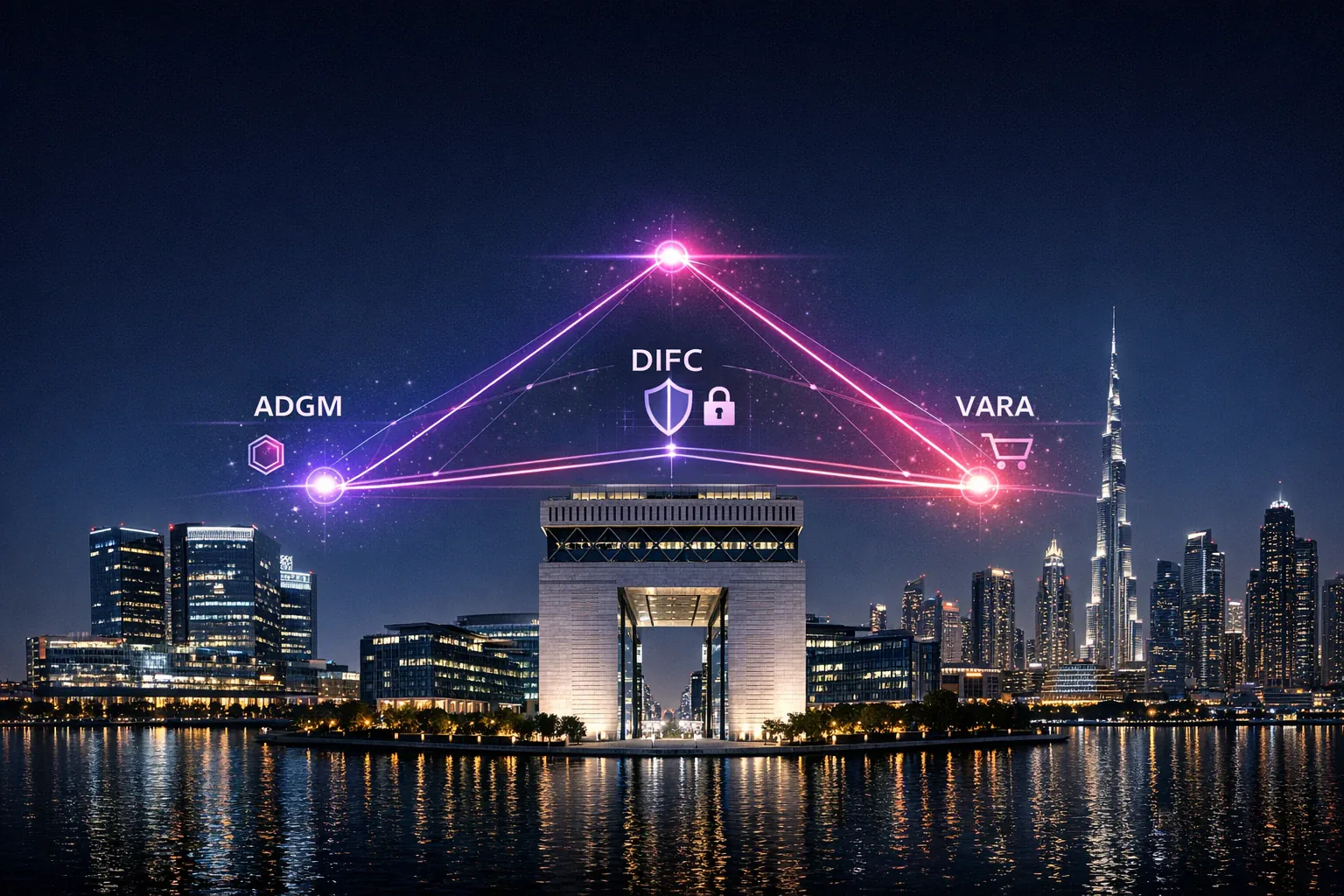
Crypto Dispute Resolution in the UAE: How ADGM, DIFC, and VARA Courts Handle Blockchain Legal Cases

Crypto Dispute Resolution in the UAE: How ADGM, DIFC, and VARA Courts Handle Blockchain Legal Cases

Crypto Dispute Resolution in the UAE: How ADGM, DIFC, and VARA Courts Handle Blockchain Legal Cases

Crypto Dispute Resolution in the UAE: How ADGM, DIFC, and VARA Courts Handle Blockchain Legal Cases

Stephan Roberto - CTO & Web3 Technical Director

Written by

Stephan Roberto

CTO & Web3 Technical Director

Published on

Mar 9, 2026

dispute resolution ADGM DIFC VARA

Get the quick brief from your AI

Get the quick brief from your AI

ChatGPT

ChatGPT

Perplexity

Perplexity

Grok

Grok

Gemini

Gemini

Claude

Claude

Gemini

Claude

The UAE doesn't have one system for handling crypto disputes. It has three. And choosing the wrong one can cost you months, hundreds of thousands of dirhams, and a judgment that's difficult to enforce.

ADGM courts apply English common law directly, with blockchain-verified judgments enforceable in 160+ countries. DIFC's Digital Economy Court has established that crypto assets are property, recoverable through freezing orders and injunctions. VARA's Grievance Committee handles retail and Web3 disputes through regulatory enforcement rather than traditional litigation.

Each framework operates under different legal principles, different languages, and different enforcement mechanisms. This guide breaks down how each system actually works, the case law shaping outcomes, and the enforcement powers regulators hold over crypto businesses operating in the UAE.

For a practical walkthrough on what to do when a specific dispute arises, including shareholder agreement review, exit mechanisms, and deadlock provisions, see our co-founder dispute resolution guide.

Quick Reality Check: What You Need to Know

  • Three distinct legal systems with fundamentally different approaches: English common law (ADGM), independent common law (DIFC), and UAE civil law (VARA)

  • DIFC courts have ruled that crypto assets are property and that ownership equals control of private keys, not account registration

  • ADGM launched "The ADGM Book" in October 2025, putting commercial judgments on blockchain for instant global verification

  • Binance restructured its entire global platform under ADGM law effective January 5, 2026, with ICC arbitration replacing previous Hong Kong arrangements

  • VARA fined 19 firms in a single enforcement action in 2025, with penalties ranging from AED 100,000 to AED 600,000

  • Language matters: ADGM and DIFC proceedings run in English; VARA-related mainland cases default to Arabic

Quick Navigation

How Does UAE Law Classify Crypto Assets as Property?

Before you can recover stolen crypto or enforce a claim against digital assets, the court needs to recognize those assets as property. Each UAE jurisdiction has taken a different approach to this fundamental question, and the answer shapes everything from interim remedies to enforcement.

DIFC provides the clearest statutory answer through the Digital Assets Law (DIFC Law No. 2 of 2024), which defines digital assets as unique units independent of any individual or system. ADGM takes a technology-neutral approach, treating digital securities the same as traditional securities. VARA regulates specific activities rather than classifying assets as property per se.

The Control-Equals-Ownership Doctrine

The most significant legal development came from the DIFC Court of Appeal in the Gate Mena DMCC & Huobi Mena FZE v Tabarak Investment Capital Limited & Christian Thurner case. This dispute involved 300 Bitcoin stolen through a vulnerability in a Trezor hardware wallet. At the time of theft in February 2020, the Bitcoin was valued at approximately AED 11.0 million. By November 2021, the value had fluctuated to roughly AED 67.2 million.

Justice Michael Black KC, Head of the Digital Economy Court, established a critical legal principle: crypto assets are property, and ownership is determined by control, specifically possession of private keys or seed phrases.

This ruling has practical implications for every virtual asset business operating in the UAE. If you lose control of your private keys, proving ownership becomes substantially harder. And if someone gains unauthorized access to your keys, they have effectively taken your property.

How Each Jurisdiction Classifies Digital Assets

Classification Aspect

ADGM

DIFC

VARA

Legal Basis

Technology-neutral securities treatment

Digital Assets Law No. 2 of 2024

Bespoke VA regulatory framework

Property Status

Implied through securities treatment

Explicit statutory definition

Regulated activity, not property classification

Ownership Test

Case-by-case evaluation

Control (private key possession)

Regulatory compliance-based

Relevant Precedent

Binance/Nest restructuring (2026)

Huobi v Tabarak (2024)

Enforcement actions against VASPs

For businesses structuring their token projects, understanding these classifications is essential. Our guide on key legal considerations for token launches covers how to navigate these distinctions from the outset.

How Do ADGM Courts Handle Blockchain Disputes?

ADGM Courts were the first in the Middle East to directly apply English common law, including established equity principles and nearly 50 English statutes under the Application of English Law Regulations 2015. The doctrine of precedent ensures consistent outcomes, and in cases where law and equity conflict, equity prevails.

This matters for crypto disputes because English common law has centuries of precedent on property rights, trusts, and fiduciary duties that translate naturally to digital asset disputes. Concepts like constructive trusts, tracing, and equitable remedies give ADGM courts a sophisticated toolkit that purpose-built crypto regulations lack.

Blockchain-Verified Judgments: The ADGM Book

In November 2022, ADGM Courts introduced a blockchain-based system for enforcing commercial judgments worldwide. This evolved into "The ADGM Book," launched in October 2025. The system publishes judgments on blockchain, enabling instant verification of authenticity through an API or the ADGM website.

The practical impact is significant. Traditional cross-border enforcement requires authenticating documents through consular channels, a process that takes weeks and costs thousands. Blockchain verification reduces this to seconds. For crypto disputes where assets move across borders in minutes, speed of enforcement can mean the difference between recovery and loss.

The FSRA's Regulatory Oversight

The Financial Services Regulatory Authority (FSRA) oversees all virtual asset service providers operating within ADGM. Rather than treating "crypto" as a single category, the FSRA regulates specific activities: operating Multilateral Trading Facilities, providing custody, offering investment advice, and dealing in investments.

VASPs must obtain Financial Services Permission and comply with Chapter 17 rules on custody, disclosure, and market conduct. The FSRA also mandates an "Accepted Virtual Assets" approval process. Following June 2025 amendments, the framework moved to a notification-based self-assessment process with predefined criteria. Capital requirements are activity-dependent, with custodians now requiring a minimum of AED 5 million and trading venues needing reserves covering 12 months of operating costs.

Privacy tokens and algorithmic stablecoins are explicitly prohibited within ADGM. The FSRA expanded its product intervention powers in 2025, giving it authority to restrict or ban specific virtual assets if needed.

For a detailed breakdown of ADGM license categories and the application process, see our ADGM crypto license guide.

Case Study: Binance's ADGM Restructuring

The most significant recent development in ADGM's dispute resolution landscape is Binance's restructuring. Effective January 5, 2026, Binance transitioned its global platform to a fully regulated structure within ADGM through three licensed entities:

Entity

Role

Dispute Relevance

Nest Exchange Limited

Recognized Investment Exchange (Multilateral Trading Facility)

Claims regarding system outages, matching errors, and trading execution

Nest Clearing and Custody Limited

Recognized Clearing House with custody permissions

Claims regarding frozen assets, withdrawals, custody failures, and insolvency

Nest Trading Limited

Broker-Dealer for off-exchange services

Claims regarding OTC pricing fairness, conversion services, and proprietary trading

The 2026 Terms of Use mandate ICC arbitration seated in ADGM, replacing the previous Hong Kong arrangement. Under the old terms, users contracted with vaguely defined "Binance Operators." Courts in multiple jurisdictions criticized this opacity. The new structure segregates liability clearly: filing a claim against the wrong Nest entity risks dismissal for lack of standing.

This restructuring signals where institutional crypto is heading. ADGM's framework treats crypto businesses as full financial institutions, with the same capital, conduct, market abuse, and AML requirements applied to securities firms. For disputes, it means ADGM courts will increasingly handle cases involving institutional-grade crypto operations governed by English common law.

How Do DIFC Courts Enforce Digital Asset Rights?

DIFC Courts operate under an independent common law system inspired by English legal principles, but with their own judicial framework. This distinction matters: DIFC has crafted tailored legislation, including the Digital Assets Law, that addresses crypto-specific questions English law hasn't fully resolved.

The DIFC Digital Economy Court, operating under Part 58 of the DIFC Court Rules, handles technology-driven disputes including those involving blockchain, smart contracts, and digital assets. The court is staffed with international judges experienced in technology-related cases and offers expedited timelines compared to mainland courts.

The Huobi v Tabarak Case: Setting Precedent

The Gate Mena DMCC & Huobi Mena FZE v Tabarak Investment Capital Limited & Christian Thurner ruling is the most important crypto case to come out of UAE courts. Beyond establishing that crypto assets are property, Justice Black KC provided guidance on several practical questions:

What constitutes possession of crypto assets? Control, in both its positive sense (ability to transfer) and negative sense (ability to exclude others). This mirrors how possession works for physical property but adapted for the digital context.

What happens when custody arrangements fail? The court found that both Huobi and Tabarak had acted under an innocent misapprehension that their agreed modalities were sufficient to protect the Bitcoin until payment. They were not. This ruling puts every crypto exchange and custodian on notice: informal custody arrangements carry real legal risk.

How are stolen crypto assets traced? The DIFC Digital Economy Court uses blockchain intelligence tools like Crystal Intelligence for tracking transactions and employs regulated custodians such as Zodia Custody to safeguard disputed assets during proceedings.

DIFC Interim Remedies for Crypto Fraud

DIFC Courts provide urgent interim remedies essential for crypto cases:

Remedy

Application

Speed

Worldwide Freezing Orders (WFOs)

Block transfer of digital assets across borders

Emergency applications by phone

Injunctions Against "Persons Unknown"

Target unidentified wallet holders

Full hearing within three days

Search Orders

Secure digital evidence from devices and wallets

Expedited on notice of risk

Norwich Pharmacal Orders

Force exchanges to disclose customer identities

Available on showing prima facie case

These remedies work because of DIFC's statutory framework. The Digital Assets Law provides legal certainty that courts have jurisdiction over digital assets, even when the assets exist on a decentralized blockchain with no physical location.

DFSA Regulation of Crypto Businesses in DIFC

The Dubai Financial Services Authority (DFSA) oversees crypto businesses within DIFC. On January 12, 2026, the DFSA transitioned from a prescriptive "Recognised Crypto Token" list to a firm-driven "Suitable Crypto Token" framework. Under this new system, authorized firms must independently assess token suitability based on technology, security, regulatory compliance, and financial crime risks. Assessments must be updated at least every six months, with findings disclosed publicly.

Token Category

DFSA Status (as of January 2026)

Bitcoin (BTC), ETH, XRP

Subject to firm-led suitability assessment

USDC, EURC, RLUSD

DFSA-recognized Fiat Crypto Tokens

Privacy Tokens

Strictly prohibited

Algorithmic Stablecoins

Strictly prohibited

NFTs / Utility Tokens

"Excluded Tokens" requiring AML/CTF registration

The DFSA eliminated the AED 18,350 fee for token recognition applications under the new framework, reducing compliance costs. Authorized entities must keep regulated crypto activities separate from unregulated NFT or utility-token operations (except custody) to avoid regulatory penalties.

This framework is relevant for dispute resolution because DFSA compliance (or lack of it) frequently forms the basis of enforcement actions and civil claims in DIFC courts. For businesses exploring DIFC, our DIFC license cost breakdown provides the financial picture, and our DIFC Innovation Hub guide covers sandbox options.

What Enforcement Powers Does VARA Have Over Crypto Businesses?

VARA takes a fundamentally different approach to dispute resolution than ADGM or DIFC. Rather than operating independent courts, VARA uses regulatory enforcement combined with an internal grievance process. If ADGM and DIFC are courtrooms, VARA is a regulator with teeth.

Every VASP operating in Dubai must appoint two Responsible Individuals who are full-time employees and UAE residents or passport holders. These individuals are personally accountable for the entity's compliance. That personal liability creates strong incentives to avoid disputes in the first place.

VARA's Grievance and Complaint Process

VASPs must establish internal complaint procedures before matters escalate to VARA. The timelines are strict:

Stage

Requirement

Deadline

Acknowledgment

Written acknowledgment to complainant

Within 1 week

Standard Resolution

Complete resolution with outcome communicated

Within 4 weeks

Extended Resolution

Update at 4-week mark if unresolved

Maximum 8 weeks total

Record Retention

All complaints, actions, and outcomes documented

Minimum 8 years

VASPs must offer straightforward, multi-channel complaint forms and cannot charge fees for handling complaints. If enforcement becomes necessary, VARA established its Grievance Committee in June 2023 as a specialized forum where regulated entities can appeal enforcement actions.

For businesses navigating VARA's complaint requirements as part of their licensing obligations, our VARA license cost guide covers the full compliance picture, including these often-overlooked operational requirements. See also our analysis of the real cost of a VARA license for what these obligations mean for your budget.

Recent VARA Enforcement Actions

VARA has demonstrated increasingly aggressive enforcement. In 2025, the authority fined 19 companies in a single action for carrying out unlicensed virtual asset activities and breaching marketing regulations. Penalties ranged from AED 100,000 to AED 600,000, calibrated to the seriousness and scope of violations.

Notable enforcement actions include:

Morpheus Software Technology FZE (FUZE): Received cease-and-desist orders, financial penalties, and was required to appoint a "Skilled Person" after failing to comply with AML programme controls and governance standards, as well as engaging in unlicensed virtual asset activities.

Vesta Prime Portal Co. L.L.C (Vesta Investments): Issued cease-and-desist orders and financial penalties for unlicensed advertising and marketing of virtual asset activities in Dubai, and for misrepresenting its licensing status.

The Open Network Foundation (TON): Penalized and issued a cease-and-desist order in July 2025 for violations of VARA Marketing Regulations.

VARA's enforcement authority extends further than many businesses realize. The regulator can revoke or suspend a license if a VASP fails to settle a court judgment, whether issued in the UAE or internationally, within 30 calendar days of the judgment becoming final. Even after an entity ceases to be regulated by VARA, it remains subject to the authority's regulations and directives for 10 years.

For practical guidance on structuring your VASP operations to avoid these enforcement risks, review our VARA regulations overview and VASP requirements guide.

What Does It Cost to Litigate a Crypto Dispute in the UAE?

Nobody publishes the real numbers on crypto litigation costs in the UAE. Here's what you should actually budget, based on market experience across ADGM, DIFC, and VARA proceedings.

Litigation Cost Comparison (Market Estimates)

Cost Component

ADGM Arbitration

DIFC Courts

VARA Grievance Process

Filing/Application Fees

Varies by claim value + ICC admin fees

Based on claim value (published schedule)

No formal filing fees

Arbitrator/Judge Fees

AED 200,000-500,000+ (three-member tribunal)

Included in court fees

N/A (regulatory process)

Legal Representation

AED 300,000-1,500,000+

AED 200,000-1,000,000+

AED 50,000-300,000

Expert Witnesses (Blockchain)

AED 50,000-200,000

AED 50,000-200,000

Typically not required

Forensic Blockchain Analysis

AED 30,000-150,000

AED 30,000-150,000

AED 20,000-80,000

Document Translation

Minimal (English proceedings)

Minimal (English proceedings)

Significant (Arabic for mainland)

Typical Total Range

AED 600,000-2,500,000+

AED 300,000-1,500,000+

AED 100,000-500,000

Typical Duration

6-18 months

3-12 months

1-6 months

These are market estimates based on industry experience. Actual costs vary significantly by case complexity and claim value. Disputes involving cross-border asset tracing or multiple parties will sit at the higher end.

The DIFC Small Claims Tribunal handles disputes valued at AED 500,000 or less (up to AED 1,000,000 with both parties' consent), and you can represent yourself without legal counsel. This is often the most cost-effective path for smaller crypto disputes. For context on DIFC costs more broadly, see our DIFC license cost analysis.

The Hidden Cost: Language

ADGM and DIFC courts operate entirely in English. Mainland Dubai courts, which handle VARA-related matters that escalate beyond the Grievance Committee, conduct proceedings in Arabic. Every document must be translated by a certified translator, and local Arabic-speaking advocates must be engaged. Budget an additional AED 50,000-150,000 for translation and local counsel in mainland proceedings.

How Do Cross-Border Crypto Judgments Get Enforced?

Getting a judgment is only half the battle. Crypto assets don't respect borders, and the party you're suing may have assets scattered across multiple jurisdictions. Here's how enforcement actually works.

New York Convention Enforceability

The UAE joined the New York Convention on August 21, 2006. Arbitration awards from both ADGM and DIFC are enforceable in over 160 countries through this framework. This is why institutional crypto players overwhelmingly prefer arbitration, it provides a well-established global enforcement mechanism.

Binance's shift to ICC arbitration seated in ADGM reflects this reality. A three-member ICC tribunal under ADGM law produces an award that can be enforced in virtually any major financial center. Court judgments, by contrast, require bilateral enforcement treaties that the UAE doesn't have with every relevant jurisdiction.

ADGM's Blockchain Verification Advantage

The ADGM Book cuts through traditional enforcement bottlenecks. Instead of authenticating paper judgments through consular channels, counterparties can verify judgment authenticity instantly through blockchain. This removes a common delay tactic where judgment debtors challenge the authenticity of foreign court documents.

Enforcement Across UAE Jurisdictions

Enforcement Scenario

Mechanism

Practical Consideration

ADGM award in Dubai mainland

ADGM Courts execute directly

Coordinate with Dubai Execution Court

DIFC judgment in Abu Dhabi

Judicial cooperation framework

Additional procedural steps required

VARA enforcement internationally

Limited direct mechanism

VARA can revoke license for non-compliance with foreign judgments

Foreign judgment in UAE

Bilateral treaty or reciprocity

Country-specific; not all jurisdictions covered

For businesses with international co-founders or investors from jurisdictions like Singapore or Cayman, this enforcement landscape is critical to understand when structuring founding documents. Our guide on DAO structuring covers how decentralized ventures can plan for these contingencies.

What Compliance Strategies Help Avoid Disputes?

The cheapest dispute is the one you never have. Operating within the UAE's crypto ecosystem requires understanding the licensing timelines and capital requirements unique to each jurisdiction, and building compliance infrastructure that prevents conflicts from arising.

Licensing and Capital Requirements Comparison

Requirement

VARA (Dubai)

ADGM (Abu Dhabi)

DIFC

Typical Licensing Timeline

8-12 months

6-10 months [VERIFY: varies widely by activity]

6-9 months

Capital Range

AED 100,000 - AED 1,500,000+

Activity-dependent (AED 5M+ for custodians; 12 months operating costs for trading venues)

Activity-dependent (consult DFSA)

Audit Frequency

Semi-annual reserve audits for ARVA issuers + monthly public disclosures

Annual (standard)

Annual (standard)

Regulatory Focus

Retail platforms, Web3, NFT marketplaces, RWA tokenization

Institutional custody, crypto funds, trading operations

Traditional finance integration, securities tokenization

Capital requirements vary significantly based on specific permissions and prudential calculations. These ranges are indicative. For current figures, consult each regulator directly or see our guides on ADGM costs and VARA costs.

Dispute Prevention Through Contracts

The single most effective dispute prevention strategy is specifying governing law and dispute resolution mechanisms in your founding documents. Ambiguities here, such as combining arbitration with court jurisdiction or failing to designate a specific forum, lead to expensive preliminary disputes that drain resources before anyone addresses the substantive issues.

Key contract provisions that prevent disputes:

Governing law clause: Specify ADGM, DIFC, or UAE federal law. Don't leave it ambiguous.

Dispute resolution forum: Name the specific court or arbitration institution. Include the arbitration seat (physical location) explicitly.

Asset location provisions: Confirm where digital assets are held, which custodian controls them, and which jurisdiction governs the custody arrangement.

Regulatory compliance obligations: Define who bears responsibility for maintaining VARA, ADGM, or DFSA compliance, and what happens if compliance lapses.

For a step-by-step guide on building these protections into your shareholder agreement, including IP assignment clauses, exit mechanisms, and deadlock provisions, our crypto co-founder dispute guide provides the complete playbook.

VARA Compliance as Dispute Prevention

VARA's licensing requirements force businesses to document roles, governance frameworks, and financial controls from the outset. The Whitepaper Schedule 1 requirements mandate disclosure of management identities, use of proceeds, and governance structures. The complaint procedure requirements create formal mechanisms for internal grievances. And the requirement that VASPs function as independent legal entities with proper agreements prevents the informal arrangements that breed co-founder disputes.

For businesses building tokenized asset platforms, SPV structures for tokenized assets, or real estate tokenization ventures, these compliance foundations double as dispute prevention architecture.

Frequently Asked Questions

Can I recover stolen cryptocurrency in the UAE?

Yes, but you need clear and verifiable proof of ownership. Following the Huobi v Tabarak ruling, DIFC courts recognize crypto assets as property recoverable through court orders. You'll need blockchain transaction records, expert reports confirming transfers, and documentation linking you to the relevant wallet. DIFC's Digital Economy Court uses blockchain intelligence tools to trace stolen assets and can issue Worldwide Freezing Orders to prevent further transfers. Speed matters, so engage legal counsel immediately.

How long does crypto dispute resolution typically take in the UAE?

It depends on the forum. VARA's grievance process can resolve matters in 1-6 months. DIFC court proceedings typically take 3-12 months, with the Small Claims Tribunal offering faster resolution for claims under AED 500,000. ADGM arbitration runs 6-18 months depending on complexity. Cross-border cases involving asset tracing across multiple jurisdictions take longer. Having complete documentation and clear contractual jurisdiction provisions from day one significantly reduces timelines.

Can I sue a crypto exchange in Dubai?

Yes, but you need to identify the correct legal entity and jurisdiction. Following Binance's restructuring, claims must be directed at the specific Nest entity responsible for the service in question. Filing against the wrong entity risks dismissal. Check whether the exchange is VARA-licensed (Dubai mainland), ADGM-regulated, or DIFC-authorized. The exchange's Terms of Use will specify the governing law and dispute forum. If the exchange is unlicensed, report it to VARA and consider filing in the court that has jurisdiction over the entity's registered address.

Is arbitration or litigation better for crypto disputes in the UAE?

For institutional disputes, arbitration seated in ADGM is generally preferred. It offers confidentiality, the ability to appoint arbitrators with blockchain expertise, and enforceability in 160+ countries through the New York Convention. For urgent matters requiring freezing orders or injunctions, DIFC courts are often more appropriate because arbitrators typically lack the power to issue emergency interim relief. For retail consumer disputes, VARA's regulatory enforcement process is faster and cheaper. Many crypto businesses use a hybrid approach: arbitration for the main dispute with court applications for interim remedies.

What evidence do I need for a crypto fraud case in the UAE?

Compile blockchain transaction records showing the flow of assets, screenshots of wallet addresses and balances (timestamped), correspondence with the counterparty, smart contract audit reports if relevant, and expert testimony linking wallet addresses to specific individuals or entities. UAE courts place significant weight on written evidence over verbal accounts. For DIFC proceedings, the Digital Economy Court accepts blockchain analytics reports from providers like Crystal Intelligence as forensic evidence.

Do I need a physical presence in a jurisdiction to file a crypto dispute there?

Not necessarily. DIFC offers an "opt-in" jurisdiction mechanism where parties can agree in their contracts to use DIFC courts even without a DIFC presence. ADGM arbitration is available if your arbitration clause specifies ADGM as the seat. However, VARA's grievance process is limited to disputes involving VARA-licensed entities. For businesses without a UAE presence, enforcing against a UAE-based entity typically requires engaging local counsel who can appear before the relevant court.

What happens if a VARA-licensed entity refuses to comply with a court judgment?

VARA can revoke or suspend the entity's license if it fails to settle a court judgment, whether issued in the UAE or internationally, within 30 calendar days of the judgment becoming final. This is a powerful enforcement lever because license revocation effectively shuts down the business. Even entities that cease to be VARA-regulated remain subject to VARA's regulations for 10 years after de-registration.

How do I choose between ADGM and DIFC for a crypto case?

Consider your priorities. ADGM offers direct English common law application, blockchain-verified judgments, and is becoming the preferred hub for institutional crypto (Binance's restructuring reinforces this). DIFC offers the Digital Economy Court with specialized crypto expertise, the Digital Assets Law providing statutory certainty, and the Small Claims Tribunal for disputes under AED 500,000. If confidentiality is paramount, ADGM arbitration is private. If you need urgent freezing orders, DIFC courts can process emergency applications by phone. If your dispute involves DeFi protocols or complex smart contract issues, ADGM's ability to appoint technically expert arbitrators may be advantageous.

Can VARA enforce penalties against entities operating outside Dubai?

VARA's jurisdiction covers the Emirate of Dubai (excluding DIFC). For entities outside Dubai, VARA can issue cease-and-desist orders and public warnings, but direct enforcement depends on cooperation with other regulators or the Dubai courts. VARA's enforcement actions against TON Foundation and other entities demonstrate willingness to act against international organizations marketing to Dubai residents. Cross-border enforcement requires coordination with relevant authorities, and in practice, the reputational damage from a public VARA enforcement action often has more impact than the financial penalties themselves.

What should my crypto business contracts include to prevent jurisdiction disputes?

At minimum: explicit governing law (ADGM, DIFC, or specific UAE federal law), named dispute resolution forum, arbitration seat designation, language of proceedings, service of process provisions, and a clear statement excluding other jurisdictions. For crypto trading platforms, include separate dispute provisions for different service types (trading, custody, advisory). Our co-founder dispute guide provides detailed contract clause recommendations and a full decision framework for forum selection.

Next Steps: Protect Your Business Before Disputes Arise

Navigating crypto disputes across three UAE jurisdictions requires understanding not just the legal frameworks, but how they interact with each other and with international enforcement mechanisms. The stakes are too high for guesswork.

Why Choose Ape Law for Crypto Dispute Resolution

We've guided dozens of blockchain businesses through dispute resolution across ADGM, DIFC, and VARA. Our expertise spans:

  • Dispute Resolution Strategy: Assessment of optimal forum, enforcement pathway, and cost-benefit analysis for your specific situation

  • Regulatory Enforcement Defense: Representation before VARA's Grievance Committee and navigation of FSRA/DFSA investigations

  • Contract Drafting: Jurisdiction clauses, arbitration provisions, and dispute resolution mechanisms that prevent conflicts

  • Cross-Border Enforcement: International judgment recognition and coordination with foreign counsel across 160+ New York Convention jurisdictions

Our Dispute Resolution Track Record

While client confidentiality prevents naming specific parties, we've handled:

  • Multi-million dirham asset recovery proceedings in DIFC involving stolen cryptocurrency traced across multiple blockchains

  • VARA enforcement defense for licensed VASPs facing compliance investigations

  • Cross-border arbitration under ICC rules for institutional crypto fund disputes

  • Contract restructuring for exchanges transitioning to regulated UAE frameworks

Ready to Resolve or Prevent a Crypto Dispute?

Don't wait until assets have moved or regulatory deadlines have passed. Our team combines deep knowledge of all three UAE frameworks with practical implementation experience to protect your interests.

Schedule Your Consultation Today

Get a confidential assessment of your situation, including:

  • Jurisdiction analysis and forum recommendations for your specific case

  • Cost and timeline estimates for dispute resolution

  • Contract review to identify and close jurisdiction vulnerabilities

  • Compliance gap analysis to prevent regulatory enforcement actions

Book Your Dispute Resolution Consultation | View All Services

Additional Resources

Disclaimer: This guide reflects regulations and court procedures as of early 2026. The UAE's virtual asset regulations and court rules evolve regularly. Always consult with qualified legal counsel before making decisions about dispute resolution strategy. The information provided here is for educational purposes and does not constitute legal advice.

Ape Law is a Web3-native legal firm specializing in cryptocurrency and blockchain regulations in the UAE. We provide comprehensive legal support for dispute resolution, regulatory compliance, and platform licensing across ADGM, DIFC, and VARA.

Related Reading

Ape Law Logo

Ape Law is a global law firm providing expert legal guidance for frontier projects, from M&A to global expansion, compliance, financing and more.

© 2025, Alt Legal Consultants FZ-LLC - All rights reserved.