
Without the review
- Search for one contract or perfect piece of evidence
- Treat individual messages and contributions as insignificant
- Assume the case is too weak before building the timeline
- Take action without a clear legal or commercial strategy
Case study
A founder thought his evidence was too weak. Messages, contributions and a clear timeline helped establish his position and brought the other side to settlement talks.
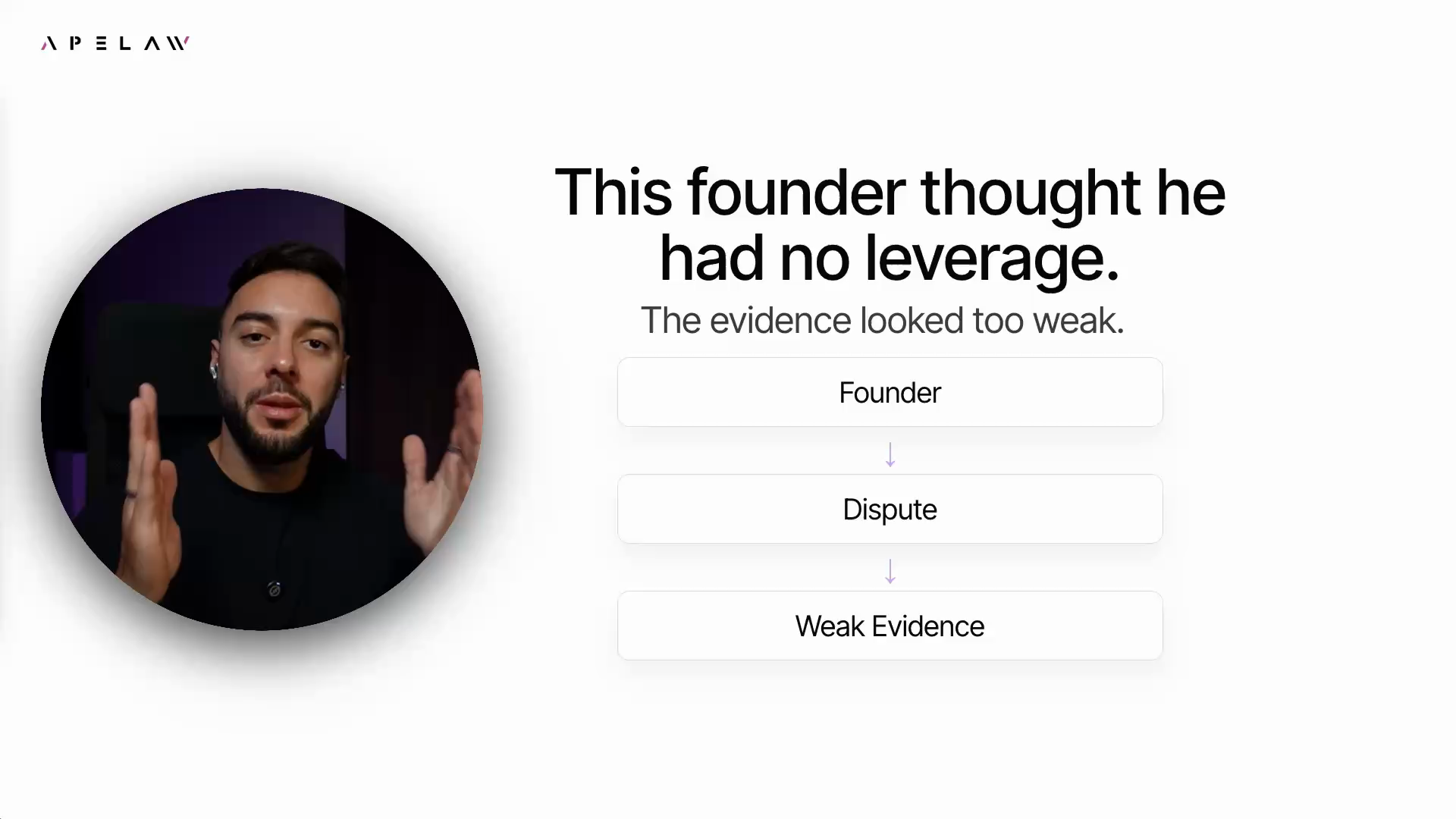 Watch the breakdown
How We Built Leverage in a Founder Dispute | Ape Law2 min 20 sec · Uploaded
Watch on YouTubeThe founder believed there was not enough evidence
A stronger position that opened settlement talks
Based on a real Ape Law matter. Certain details have been anonymised.
Get a Clear Path ForwardThe difference
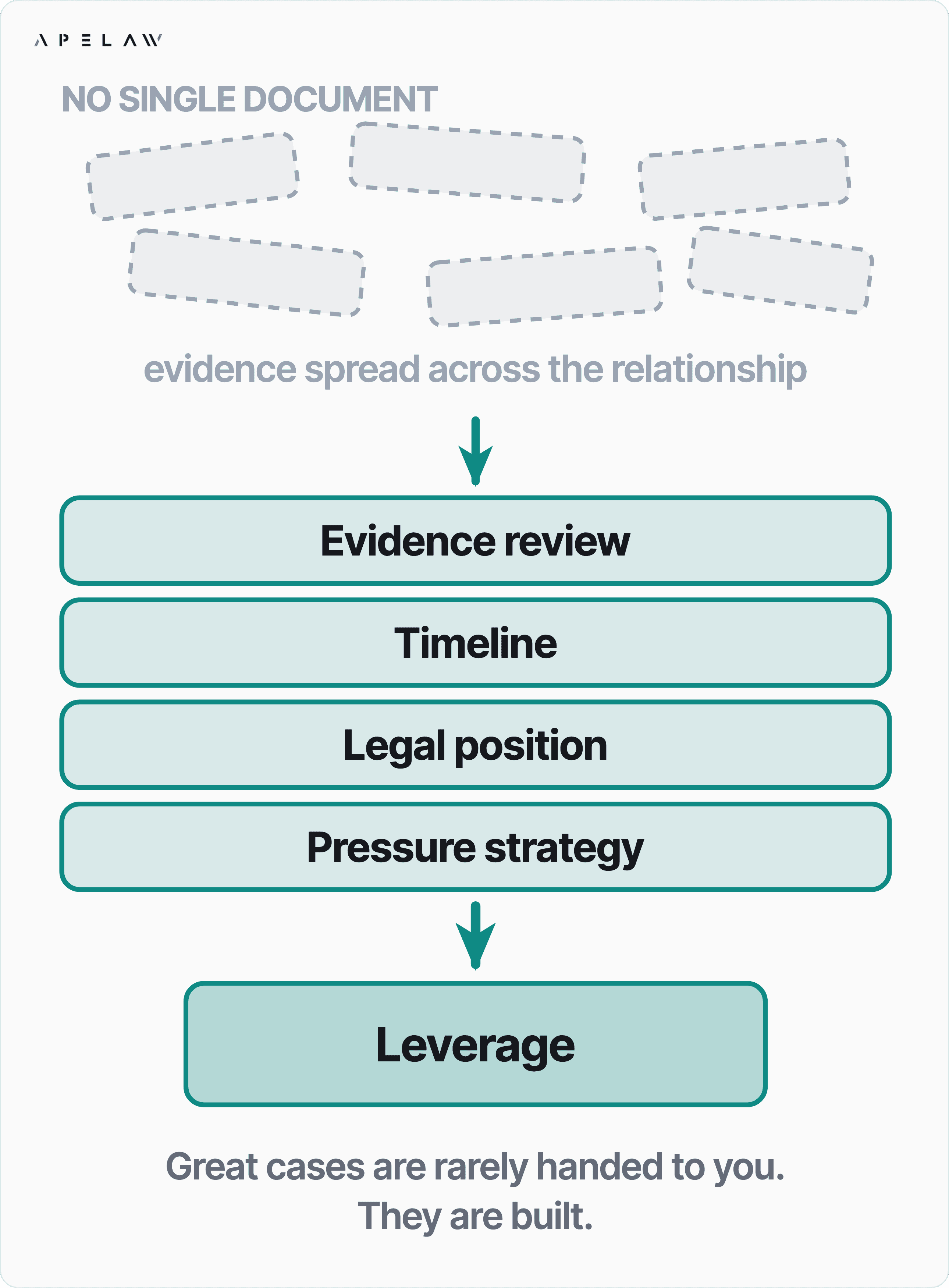
Without the review
With the review
The review
We reviewed the complete record, rebuilt the timeline and identified the facts that strengthened the founder’s legal and commercial position. Once the evidence and leverage were clear, we applied pressure through a structured dispute strategy.
Which documents, messages and records supported the founder’s version of events?
What happened, in what order, and how did each side respond?
Which contributions, promises and conduct strengthened the available claims?
How should formal correspondence and commercial pressure be applied without weakening the position?
The founder lesson
The full story
We worked with a founder who believed he had almost no leverage in a serious business dispute.
He did not have one contract or perfect piece of evidence that clearly proved his position. From his perspective, the case appeared weak before it had even started.
But that conclusion was based on looking for the wrong thing.
The founder was searching for one agreement, message or record that would prove the entire case.
That document did not exist.
This made it feel as though there was no evidence and no realistic way to apply pressure. But disputes do not always arrive as a complete file with every promise recorded in one place.
The evidence may be spread across years of messages, decisions, contributions and conduct.
Instead of searching for one perfect document, we started rebuilding the complete story.
We reviewed the messages between the parties. We mapped the timeline. We identified what the founder had contributed, which promises had been made and how both sides had behaved.
Some facts appeared minor when viewed individually. A message might not have proved the entire arrangement. A contribution might not have explained every expectation. A single action might have had more than one interpretation.
Together, however, those facts began to establish a consistent account of the relationship.
Once the timeline and evidence were organised, the founder’s legal position became much clearer.
We could identify the strongest facts, the missing information, the likely counterarguments and the areas where commercial pressure could be applied.
This changed the question from “Can we win?” to “What can we prove, and what leverage does that create?”
The founder did not need perfect evidence. He needed a credible and properly supported position.
We developed the dispute strategy and prepared formal correspondence based on the evidence that had been assembled.
The pressure was applied in a structured way. Each step was connected to the legal position, the commercial objectives and the likely response from the other side.
We continued strengthening the case and maintaining pressure. Eventually, the other side came to the settlement table.
That did not happen because one perfect document suddenly appeared. It happened because the evidence had been organised into a position that could no longer be easily dismissed.
Do not assume that a missing contract or imperfect evidence means there is no case.
Messages, timelines, contributions, promises and conduct can become important when they are reviewed together. The first job is to understand what can actually be proven.
Great cases are rarely handed to you in perfect condition. They are built from the facts that already exist.
Sometimes a founder has far more leverage than they realise.
The result described here relates to this matter. Another project's facts, rules and outcome may differ.
Talk about your project
If you are dealing with a founder conflict, broken promises, ownership disagreement or control dispute, Ape Law can help review the evidence, establish the timeline and map the legal and commercial options available.
Get Expert Advice