
Without the review
- Search for a licence before defining the product
- Assume the platform fits one regulatory category
- Choose a jurisdiction before testing the classification
- Build the technology before understanding the regulatory requirements
Case study
The founder asked which licence the platform needed. That depended on how the product worked and how different jurisdictions would classify it. The review started there.
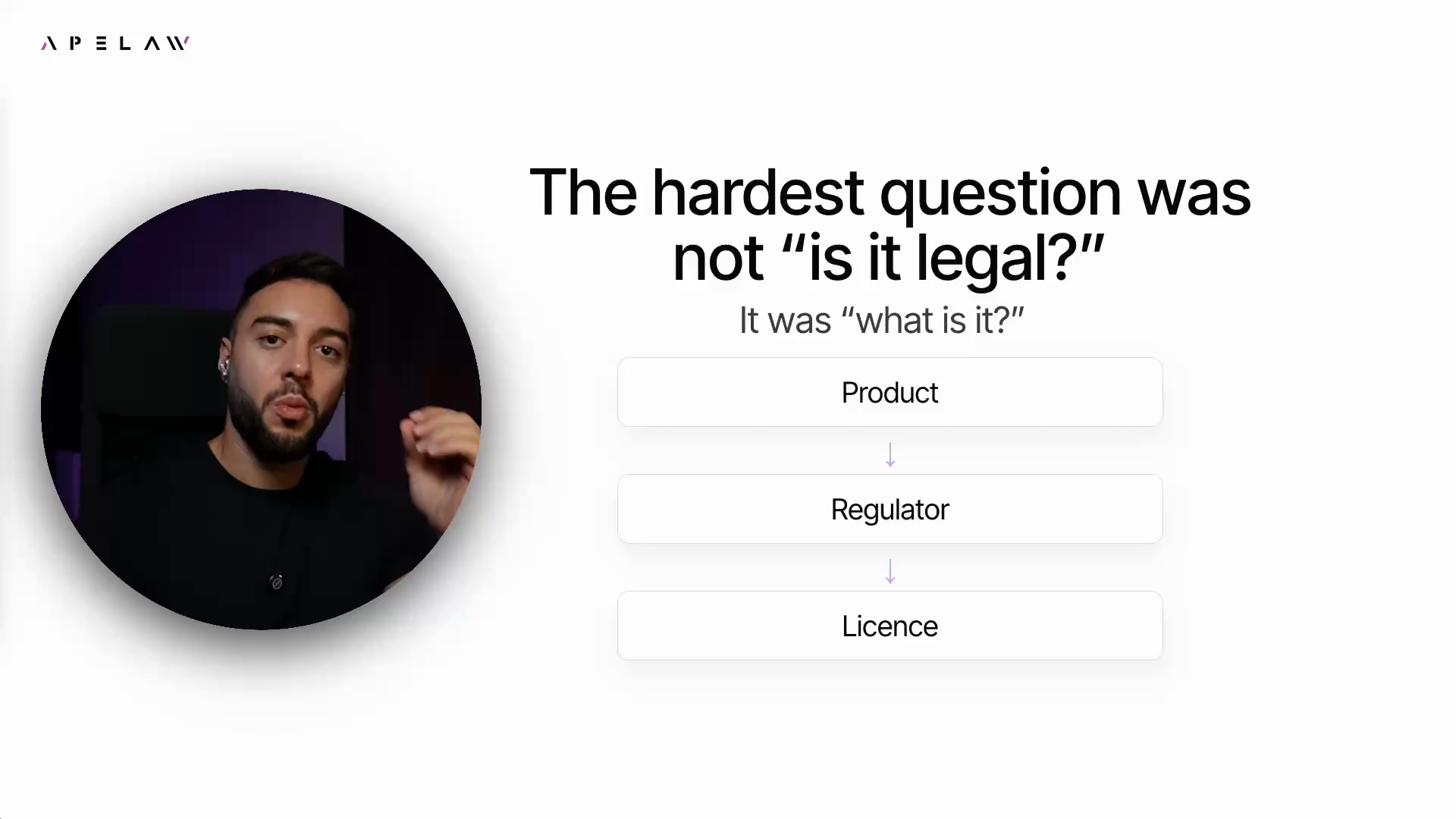 Watch the breakdown
Why This Prediction Market Needed Classification Before Licensing | Ape Law2 min 27 sec · Uploaded
Watch on YouTubeThe founder started by searching for a licence
A phased regulatory roadmap built around the product
Based on a real Ape Law matter. Certain details have been anonymised.
Get a Clear Path ForwardThe difference
Without the review
With the review
The review
We started by analysing how the prediction-market platform would work. We then considered how different jurisdictions could characterise it, mapped the possible licensing options and built a phased regulatory roadmap around the most viable pathways.
How would users participate, place positions and receive outcomes?
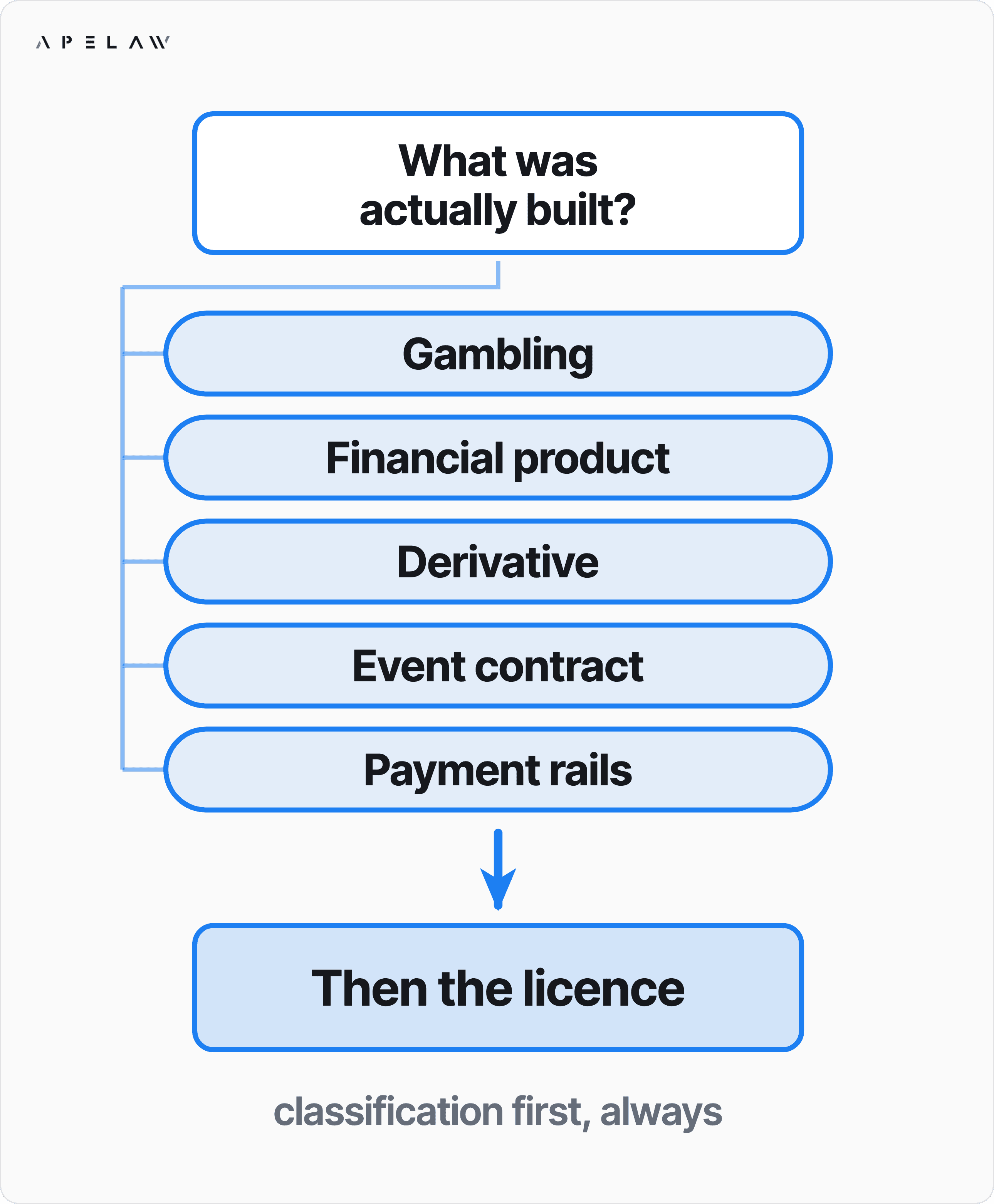
Could the product fall within gambling, financial product, derivative or event contract rules?
How would different jurisdictions treat the same product and operating model?
Which licensing, payment and technology steps should the founder take first?
The founder lesson
The full story
We worked with a founder building a prediction-market platform.
But that was not the first question the project needed to answer. Before discussing licensing, we needed to understand what the founder had actually built.
Licensing comes after classification.
A licence authorises a particular type of regulated activity. If the legal character of the product is still unclear, searching for a licence can send the project towards the wrong regulator, jurisdiction or operating model.
The prediction-market platform did not arrive with a clear regulatory label. Its classification depended on how users participated, what they paid, how outcomes were determined and what rights or returns the platform created.
The product needed to be understood before its licensing options could be assessed.
We analysed the product from several regulatory perspectives.
Could the platform be characterised as gambling? Did it create a financial product? Could the positions be treated as derivatives? Did the model resemble an event contract? Were there other regulated activities connected to operating the market or handling payments?
Each possible characterisation led to a different set of rules, regulators and licensing requirements.
This meant product design and legal analysis could not be separated. A change to the user journey, settlement process or economic model could affect the regulatory position.
The same prediction-market product could be treated differently across jurisdictions.
We examined multiple regulatory frameworks and mapped how each could apply to the proposed platform. We also considered how the jurisdiction would affect the payment rails, technology requirements, operating entities and route to market.
The goal was not simply to identify the jurisdiction with the lightest rules. It was to understand which pathway genuinely fitted the product and could support the founder’s commercial strategy.
Once the product and possible classifications were understood, we mapped the available licensing options.
The strategy was phased so the founder could make decisions in the right order. The product analysis informed the jurisdiction comparison. The jurisdiction comparison shaped the licensing options. The regulatory pathway then informed the payment and technology requirements.
The legal opinion became a roadmap for developing the project, not a document separated from the business.
Do not begin an innovative product by asking which licence it needs.
Start by understanding how the product works, what rights it creates, how value moves and how different regulators may characterise it.
Great legal strategies do not begin with a licence. They begin with the product.
Once the product is properly understood, the jurisdiction, regulatory pathway and licensing strategy become much clearer.
The result described here relates to this matter. Another project's facts, rules and outcome may differ.
Talk about your project
If your product could fall across multiple regulatory categories or jurisdictions, Ape Law can help analyse how it works, assess the possible classifications and map a regulatory pathway the team can execute.
Get Expert Advice